
One of the best things we can do for ourselves is get enough sleep. Yet, in the U.S., 50% of adults don’t get enough sleep, and 70% of teenagers are sleep deprived(opens in new tab)!
In America, we value productivity and play so highly, that we tend to dismiss the value of rejuvenation. Some of us think sleep is a waste of time. We might have a youthful optimism about sleep. We often stay up later than we should, and fool ourselves into believing we will be fine, yet the consequences of sleep deprivation can be dire!
Most of us are aware of the more immediate symptoms of sleep deprivation. We don’t react as quickly, think as well, it can be harder to concentrate, it can make us moody and irritable. And the more tired we are, the more susceptible we are to falling asleep. If we are operating heavy machinery, like a car, that could have dire consequences.
Interestingly, research shows that after 3 days of sleep deprivation, we seem to lose the awareness that we are sleep deprived. Unbeknownst to us, our judgment becomes impaired. We seem to settle into a new normal and deceive ourselves into thinking we

are fine, despite the fact that we are still experiencing the same symptoms!
If we survive the short-term effects of sleep deprivation, over the long term, we are increasing our accumulative stress burden and our risk of chronic diseases(opens in new tab), and destroying our brain.
These are my seven most compelling reasons for getting a good night’s sleep.
Weight gain
Sleep impacts several hormones that can affect our weight(opens in new tab). Poor sleep increases the stress hormone cortisol. It also increases insulin after a meal. Both insulin and cortisol promote fat storage. Cortisol seems to promote more retention of far in the stomach. Sleep deprivation also is associated with lower levels of leptin, and higher levels of ghrelin. Ghrelin stimulates appetite, while leptin tells the brain when the body has enough food. Thus sleep deprivation increases one’s risk of obesity.
Mood Disorders
Chronic sleep issues are correlated with depression, anxiety and other forms of mental distress. A recent large study(opens in new tab) showed that for teenagers, every extra hour of deprivation was correlated with 38% increased risk of sadness and hopelessness, a 42% increase in consideration of suicide and 58% increase in attempted suicide, and a 23% increased risk of substance abuse.
Your capacity for happiness itself also depends on sleep. Several daily diary studies that tracked people’s sleep and mood day by day found that better sleep quality the night before consistently predicted more positive mood the following day. One study even found sleep quality was the single best predictor of next-day mood out of everything researchers measured. Chronic sleep deprivation doesn’t just make you more irritable. It quietly lowers the ceiling on how good you’re able to feel.
Learning and memory
Sleep is essential for declarative memory(opens in new tab) (what we know), and procedural memory (remembering how to do something). We also need enough sleep to focus(opens in new tab). Judgment becomes impaired, and risk of accidents goes up when we are sleep deprived.
Self-regulation and additions
A systematic review and meta-analysis of 61 studies found that sleep-deprived people show less prefrontal cortex activity, the exact region responsible for impulse control, attention, and decision-making. A well-functioning prefrontal cortex helps you resist temptation, regulate emotional reactions, and think through consequences before acting.
Increased risk of accidents
 Sleep deprivation is thought to cause at least 20% of all motor vehicle crashes. Also according to the Institute of medicine, 50-100,000 deaths and over one million medical injuries are preventable. (opens in new tab) Many are thought due to be due to the long shifts that interns have to endure without sufficient sleep. Sleep deprivation has also played a role in numerous high profile accidents(opens in new tab), such as the Exxon Valdez oil spill, the Challenger, the nuclear accident at Three Mile Island and the nuclear meltdown at Chernobyl.
Immune Function
Chronic sleep loss is linked to a persistent low-grade inflammatory state and a weaker immune response, including higher susceptibility to colds and respiratory infections. It’s also linked to a weaker antibody response to vaccines, meaning less protection from the same shot. Your body’s ability to fight off what it’s exposed to every day depends, in part, on how well you slept last night.
Sleep cleans the brain of neurotoxins
In 2013, neuroscientists discovered that during sleep, the brain activates the glymphatic nervous system to clear out neurotoxins(opens in new tab). Specifically, the glial cells shrink during sleep, and this allows more space between the neurons to flush away the toxins. The neurotoxins that are flushed out are the ones that accumulate in neurodegenerative diseases, such as Alzheimer’s, Parkinson’s and Huntington’s disease. Researchers found this clearance system is roughly ten times more active during sleep than during waking hours.
What Chinese Medicine knows
Traditional Chinese Medicine backs up this idea that sleep is for detoxification, 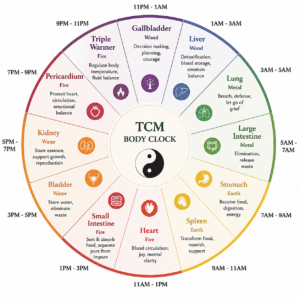 and even gives specific windows about when it happens! In TCM, the 24-hour body clock assigns each organ system a two-hour window of peak activity. Six of those windows fall overnight, and each one is tied to a different drainage or detoxification function:
- 7–9pm, Pericardium: the body’s transition into rest begins here.
- 9–11pm, San Jiao (Triple Burner): this is considered the ideal window to already be asleep, so the body can begin metabolizing and repairing.
- 11pm–1am, Gall Bladder: governs the storage and release of bile.
- 1–3am, Liver: stores and filters blood.
- 3–5am, Lungs: tied to immune function and grief processing.
- 5–7am, Large Intestine: governs elimination as the body prepares to wake.
So far, this lines up with something Western science loosly confirms. Different organ systems really do run on their own circadian rhythms, and liver metabolism and detox pathways really do peak overnight. But despite this overlap, most of us are wide awake during the exact hours our bodies are trying to drain, filter, and repair. If you’re still on your phone at 11pm, you’re not just missing sleep. You may be interrupting your body’s own drainage schedule.
To be clear, this isn’t a prescription to sleep for twelve hours a night. Most of us don’t need to cover all six windows perfectly to benefit. What matters more is which hours you’re consistently missing. Going to bed at 1am means you’re skipping the Pericardium, San Jiao, and Gall Bladder windows entirely, even if you still get a full eight hours of sleep afterward.
One more note: these windows were traditionally tied to solar time, not clock time, so your true window can shift by an hour or more with daylight saving or your location.
Why Too Many Americans Struggle With Getting Enough Sleep
Too many people are working brutally hard just to survive, and by the time the day is finally theirs, they’re stealing a few hours from sleep to reclaim “me time.” Many Americans are chronically stressed, due to difficulty paying bills, too much to do, and too much bad news. We are often addicted to screens that keep our brains wired past bedtime. Aging itself plays a role too. The pineal gland, which produces the melatonin that regulates our sleep cycle, tends to calcify over time, and that calcification is linked to worse sleep. For women, this seems to compound with the loss of estrogen around menopause, since estrogen appears to support melatonin production directly. On top of the hot flashes and night sweats can fragment sleep for years, often well past menopause itself.
Tips For Getting Good Sleep
Get natural light exposure early in the day, ideally within the first hour of waking. Morning light helps set your circadian rhythm and signals to your body when it should start winding down twelve to fourteen hours later. Getting exercise (especially in the morning) also facilitates sleep. Then, as evening comes, dim the lights and limit screens for at least the last hour before bed. The blue light from phones and computers suppresses melatonin, the hormone that tells your body it’s time to sleep, and the EMF and 5G signals are disruptive to natural sleep rhythms.
If you tend to use a phone or a screen late at night, consider banning them from your bedroom to optimize rest. Swap the scroll for an old-fashioned book instead. Reading, especially something fun, and not too addicting, is relaxing enough that it allows you to fall right asleep when you are tired.
 Japanese sleep culture has centuries of wisdom behind it. They have a number of night time rituals designed to induce relaxation, including yin yoga, mediation, a hot calming tea (like Chamomile) or a warm bath before bed. Japanese bedrooms also tend to run cool, often somewhere between 60 and 68 degrees Fahrenheit, because a cooler room supports the natural drop in body temperature that signals to the body it’s time to sleep. And there’s the philosophy of ma, which encourages minimalist design instead of clutter and stimulation in the bedroom.
If You’re Still Struggling
If you’ve tried all of this and you’re still struggling, it can be hard to break bad habits on your own. We often have subconscious barriers that get in the way of going to bed and being able to relax, and I help people release them. Plus there can be additional environmental issues and issues associated with aging, that can be addressed.
If you’ve been dealing with symptoms nobody could quite explain, and you suspect sleep is part of the puzzle, and want to know how it’s affecting you, that’s exactly what my Holistic Health Assessment is for. It now includes a look at your toxin load and your body’s ability to detox, plus an assessment of inflammation, blood flow, accumulations that build up with degeneration, allergies, autoimmune markers, and a brief nutrient assessment.
You deserve to know what’s getting in the way of your health. Click here to schedule your Holistic Health Assessment.