

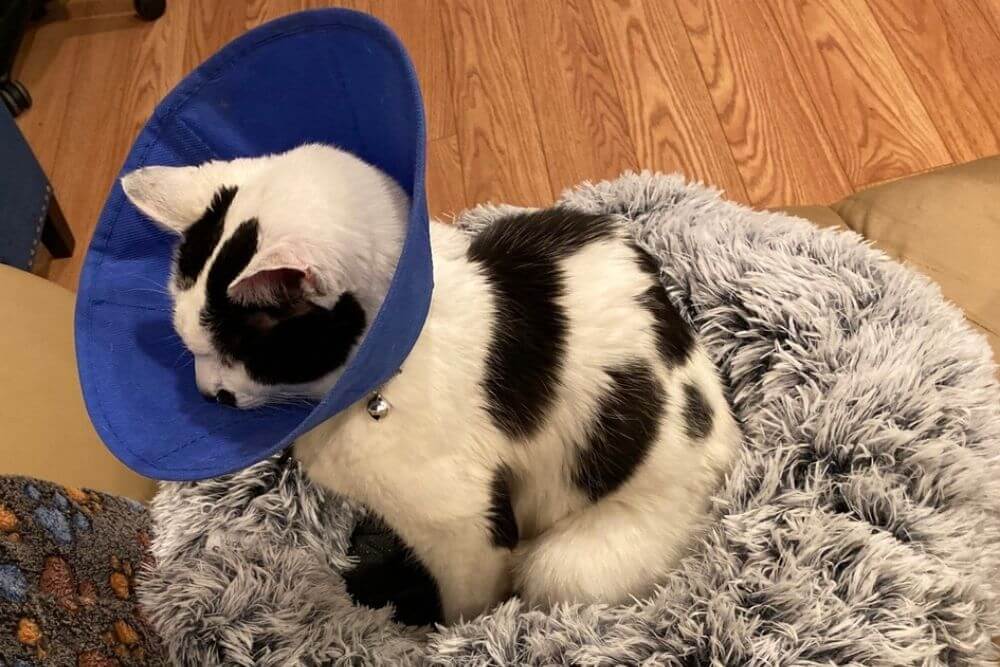
My cat has had an insane number of health issues lately.
The itchy’s started right around Christmas 2021. I worked tirelessly to relieve her of all the pathogens in her body, but she had some complicated issues and it took longer than I hoped. In the meantime she started aggressively grooming her armpit. I knew she was aggravating the area but I was so overwhelmed with addressing root causes and I didn’t have a cone for her to wear. Plus, the last time we used one was so traumatic for her I dreaded the thought of having to make her wear it!
But after working the root causes of her itchiness for a full day, I woke up to find her armpit moist and without any fur! In my panicked state I thought I was looking directly at her muscle! So I took her to the closest emergency vet hospital I could find. The vet diagnosed her with contact dermatitis, gave me a powder to soothe her skin, and on her poor little head, they put the dreaded cone of shame.
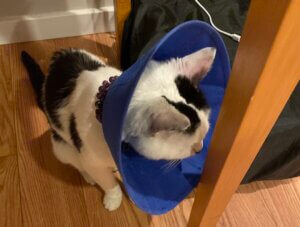
Back at home she didn’t handle the cone situation well. She’d walk a little, then bump into something, and not know what to do. At first she’d cry for help, so I tried to teach her to back up and move her head to figure out how to go forward. But she just wasn’t learning. When I returned from running an errand, I found her crouched with her cone against her cat bed, it looked like she wanted to get to her bed, but she had given up after getting stuck. It was adorable and heart breaking at the same time.
Why was she having such a hard time handling the cone?
Using the Body Code I released her frustration, lack of confidence, insecurity and limiting beliefs. I also worked on her solar plexus chakra for empowerment. These things helped the moment she was stuck, but as soon as she walked she’d get stuck again and not know what to do. She had never been a good learner but I was appalled by how much she was struggling, and how resigned to her predicament she seemed to be – something just wasn’t right!
I know from the work I do that if I’m not making progress by releasing emotions and beliefs, I need to look at the brain. And because my neuroscience research was in dementia, I immediately started inquiring about the different parts of her brain involved in motor skills. The first place I looked was the basal ganglia, an area known for it’s role in Parkinson’s disease.
While Parkinson’s disease in humans is associated with tremors and shuffling gait, earlier stages of the disease involve depression, lack of motivation and anhedonia (inability to feel pleasure). One of my human clients had struggled with the early symptoms, and restoring her basil ganglia had helped her get her life back, so it made sense to examine that area first.
My 18 year old senior citizen fur baby was clearly demonstrating a lack of motivation and desire to overcome her predicament. For weeks I had been unable to get her to play, and I had wondered why she didn’t seem happy any more. She was still motivated to chase treats, but it seemed to have an obsessive nature about it – she just wanted more, and couldn’t be satiated. While the mechanisms are complicated, according to the literature the basal ganglia is involved in more repetitive behaviors and even OCD.
We’ve also been having problems with mold and yeast exposures in the apartment, and I had already spent time clearing pathogenic hotspots in her. So, I suspected there were localized areas of infection in the basal ganglia area I had not yet found.
I was correct. I found either mold, yeast or both in areas of the basal ganglia called the substantia nigra, the external globus pallidus, her putamen, and an infected artery that fed the globus pallidus. I also found it infecting the extracellular matrix (the fascia of the brain), the white matter below the basil ganglia, and in another spot where nerves exited the subthalamic nucleus.
In each of these areas I clear pathogens either by releasing barriers for the body to do it, or by using my spirit guide to channel frequencies to the targeted infected area. The frequencies activate a program to kill specific pathogens. I then make sure the physical area is cleaned up, and any harmful Qi (organizational energy) is released. I check to see if the area (including the extracellular matrix) is getting enough nutrients, vital force energy and ATP (adenosine triphosphate). And finally, I address the ‘issues in the tissues’ (local tissue’s emotional state), and make sure they are aligned with a full recovery. My determination at the time was largely motivated by the desire to prevent Parkinson’s disease!
Seeing her struggle so much made me angry. Why would anyone invent such an awful stressful device for pets already stressed out by being sick?!? Then it began to dawn on me that her response was probably not normal.
When I went to bed the first night she wore her cone, I moved as many things as I could out of her way and restricted her access to keep her safe while I tried to sleep.
I was surprised and so relieved to see her improve in less than 24 hours! She was clearly more motivated to get out of being stuck, she had more energy, and was exploring more than I had seen her do in the last few weeks. This confirmed she did not have Parkinson’s disease as recovery of lost tissue takes months! While writing this piece I also realized, cats don’t appear to be susceptible to Parkinson’s. 🤦♀️
The next day I discovered she wasn’t getting enough oxygen in her brain, and she had reversed Qi in her right intercarotid artery (that feeds the brain). Later that night she had more energy than I’ve seen in a long time, and seemed determined to figure out ‘cone walking’ for herself! Even walking into tight spaces and finding ways to wiggle out. By the following day she had even used her litter box with the cone! In fact, at the time of writing she is managing the cone situation like a champ!
After removing some obsessive thinking about being contaminated, we could remove the cone for good – 5 days after we first put it on.
Part of me wonders if this happened so I would discover the problems in her basal ganglia. If so, I’m grateful. She’s clearly becoming healthier and purring a LOT more, and I’m relieved and proud of how far she’s come in a short time.
So, do you ever feel stuck in a cone while trying to navigate through life? If you are reading this article, think about taking the cone off. You probably didn’t need it in the first place. Share this article with your friends so they can benefit too.
And, if you want a holistic solution to your brain health, you can learn more about how I can help here.