

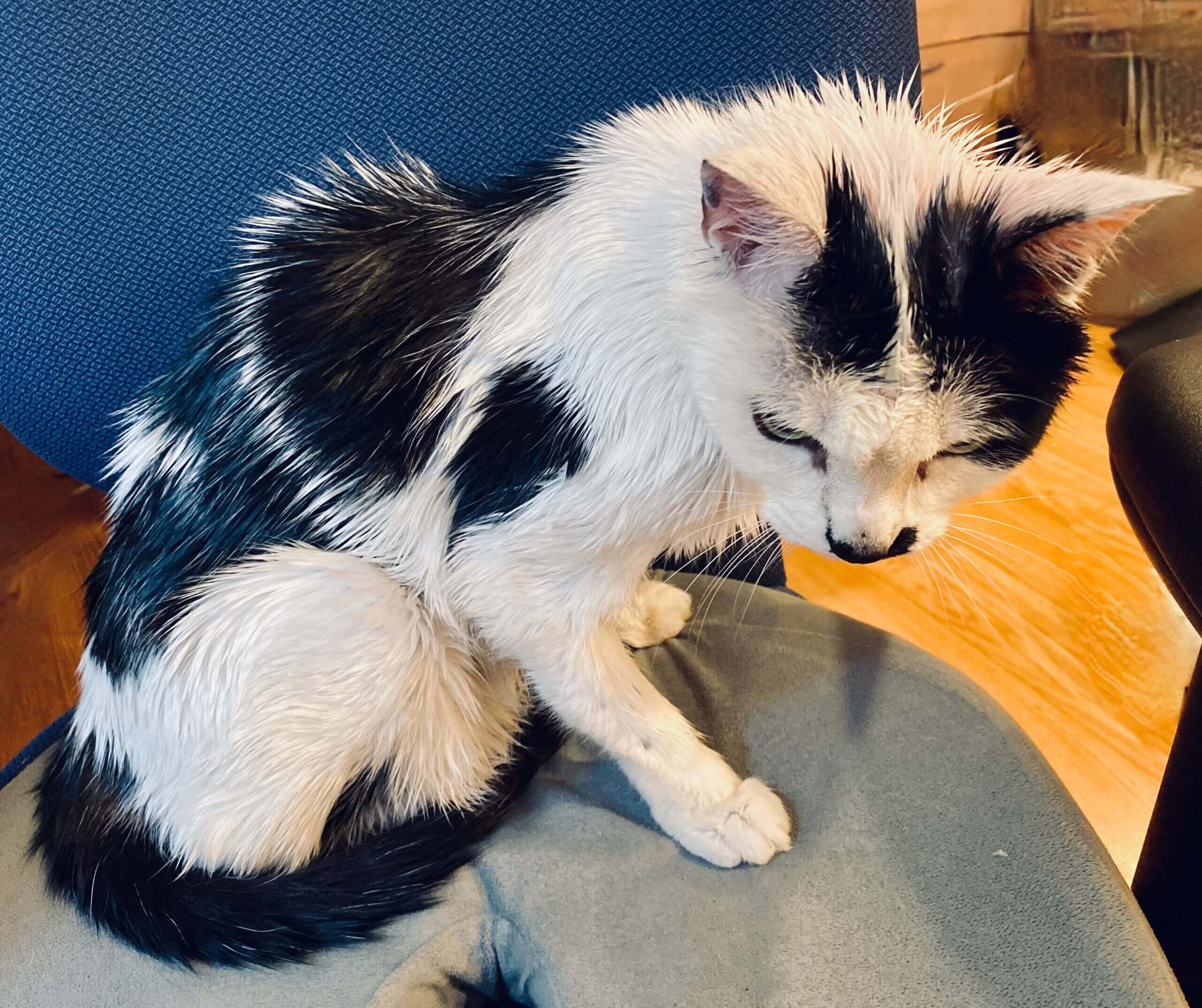
My previously healthy cat has been in dire straights with her health for the last 6 weeks. I have been working tirelessly to bring her back to health!
About six weeks ago, I kept finding RoundUp in her system. I didn’t think too much of it. I’d just clear it and we’d be fine, I naively thought. While I personally don’t use any pesticides, I didn’t realize how toxic Roundup was. But I was concerned. Where is it coming from?
The problems
My cat spends most of her time indoors, and I let her out on a leash in front of my home for up to 1 hr per day. She’s had every health issue imaginable since then and been near death twice.
I’ve found abnormally dividing cells twice (could it be cancer?), systemic autoimmune disease, maple syrup urine disease, Alzheimer’s pathology, and a right kidney almost in complete failure. I would discover and clear pathogens and toxins multiple times a day.
There were also mites & scabies, worms, a horrific 3 days where she violently threw up, and didn’t eat for 3 days, polyps in her ears, nose, and whiskers, a sinus infection, cataracts and macular degeneration in her right eye.
She also had numbness in her whiskers, nose, lips, mouth and tail, peeing on her way into the box. She also felt lots of paranoia about toxicity with her food and water. I’d clear it at every meal, and it would keep coming back, over and over for weeks…
Then I realized her paranoia was based on her reality!
Big exposure equals big problems
I realized that she has had minor Roundup exposures by going outside but a larger one around six weeks ago!
And that her microbiome was completely devoid of any beneficial bacteria!!
I looked in the literature for a link between Roundup and probiotics and found this article. It explains SO Much of what we’ve been experiencing! The article says that RoundUp can lead to dysbiosis, and the most concerning is that it can cause over growth of a bacteria, Clostridium. I realized that her microbiome was completely taken over by this toxic bacteria Clostridium! 100%! Clostridium generates toxic metabolites in the brain, and contributes to “neurological deviations’.
Here’s another paper about how Roundup causes excitotoxicity in the hippocampus (a cell death associated with Alzheimer’s neuropathology).
Also, I got that the Roundup caused her maple syrup urine disease. It inhibits the ability of the body to process specific amino acids and causes harmful substances in the blood and urine. Her maple urine syrup disease and the Clostridium were the main contributors to the Alzheimer’s pathology, and I found another paper that shows the same issues that I saw, that Maple Syrup Urine disease can lead to abnormal protein phosphorylation, which led to the Alzheimer’s pathology!
I also got that the Roundup had huge effects on her serotonin levels! No wonder she went from being a happy cat to wanting to die!
I’m quite distressed because one of my cat’s joys in life is to spend time out in my garden. I can’t believe I live in such a beautiful spot with a lovely garden, and now I’m realizing that she can’t enjoy it!
The exposure was someone’s use of RoundUp that reached my front yard. It was not from the food I served her. We are far more sensitive to the toxins in our air than most people realize. And given that she explores the world by smell and is much smaller and closer to the ground than humans, she’s far more sensitive to the chemicals that sit there!
Another paper shows that as an endocrine disruptor, glyphosate, can have an inverse dose-response relationship, where very low doses can be even more toxic than higher doses! Yeah, really! How? Read Low Doses of Hormonelike Chemicals May Have Big Effects in Scientific American.
What else is Roundup causing to others?
If Roundup (glyphosate) killed all of her pathogen fighting good bacteria, is it doing this to others?
Since my discovery just last week, I’ve found a human clients who’s microbiome had also been taken over by Clostridium due to RoundUp exposure! He is struggling with many neurological issues with vision, comprehension and memory. And he’s been exposed 9 times in the last 7 years!
I also discovered that I dog I was working with, with Diarrhea has 40% Clostridium in his microbiome, AGAIN due to RoundUp exposure!
A study found that the prevalence of RoundUp exposure went from 12% in 1993-1996 to 70% in 2014-2016!
I’m exhausted with the number of hours I’ve spent with my cats’ health. Because I have the tools and the knowledge, I’m not going to just let her go. She’s made a fabulous recovery so far. But I can only do so much about the air outside.
PLEASE PLEASE PLEASE understand how toxic Roundup is to our health and the health of our pets, our children and other creatures great and small. And please, find safer alternatives! As the article in Scientific American suggests, there are NO safe levels of RoundUP!
What can we do if we think we’ve been exposed?
Replenish your microbiome! How do you choose a good probiotic? Check out the advice from Dr. Will DePaulo, head of the Center for Microbiome Sciences and Therapeutics at UW.
The problem with RoundUp is that we don’t have enough clear answers about it’s effects. But one thing I saw clearly this week is that it can turn all those beneficial bacteria in your microbiome to toxic ones! This problem with the microbiome can be addressed by replenishing the it with healthy bacteria. How do you choose a good probiotic? Check out the advice from Dr. Will DePaulo, head of the Center for Microbiome Sciences and Therapeutics at UW. It’s at least a start.
PS: Almost after violent heaving, and not eating for three days, Tuk Tuk has made a remarkable recovery. Her immune system has improved immensely. Her appetite is good, she’s eating solid food, and she is rarely paranoid about food and water. She is however, vulnerable to setbacks.
But on the whole, more often than not, she’s in good spirits, wants to engage in her surroundings, look out the window, cuddle and go outside. Unfortunately, to go outside, I have to bring her to a part of the yard that is behind a fence and near the compost, and definitely less inviting. But at least it isn’t toxic!